
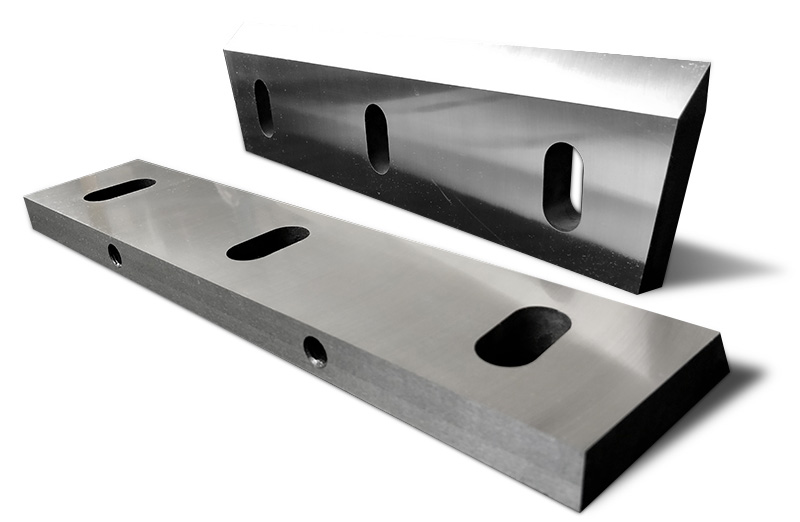
Best Material to Manufacture Granulating Blades
Blades are arguably one of the most important parts of granulators, and one of the key aspects that defines a blade is the material it is made out of. In this article, we will discuss steel alloy DIN/EN code: 1.2379 that we recommend as most suitable material to manufacture granulating blades from.
Definition of alloys
Alloys are mixtures of materials that include at least one metal. They are created by melting and mixing individual components together. Atoms do not chemically bond with each other, they are of different sizes and cause the pattern inside the material to be irregular, leading to higher melting points and strength of output material.
Steel is a specific alloy of Iron and Carbon, with Iron taking up the majority of particles in the material while Carbon and the other elements occupy much smaller amounts.
Key Terms
- Strength - maximum load before permanent deformation
- Toughness - how much energy can be absorbed before cracking or chipping
- Hardness - how difficult it is to scratch or dent
- Brittleness - aptness to break with little or no plastic deformation
1.2379 (cold-work tool steel)
1.2379, is the most suitable and widely used material for granulator blades in the recycling industry. It focusses on having extremely high wear resistance partially due to its high hardness, meaning it takes a much longer time for the material to wear off during use. This does lead to the toughness of the material being lower and the steel being more brittle, which is why it excels in applications where maximum wear resistance is paramount and impact loading is minimal, like plastics, wood or rubber with very small or metal content.
Chemical composition by weight:
| C | Si | Mn | P | S | Cr | Mo | V |
|---|---|---|---|---|---|---|---|
| 1.40 – 1.60% | 0.10 – 0.60% | 0.10 – 0.60% | ≤ 0.030% | ≤ 0.030% | 11.0 – 13.0% | 0.70 – 1.20% | 0.50 – 1.10% |
The way this steel works can be explained through its chemical composition and structure. First of all, 1.2379 has a high Carbon concentration, meaning it has many more carbides that increase its hardness. Specifically, it has Chromium-rich carbides which, are very hard ceramic particles embedded in the steel. The steel matrix holds the carbides in place and the carbides have excellent abrasion, preventing any material loss during general processing. This also means that the blade edges stay sharper for longer. The only issue with the high number of carbides is that its ability to absorb impact energy is reduced. This makes the alloy more prone to chipping under sudden impacts - like hitting a bolt or stone. So as long as impacts are moderate or controlled, 1.2379 is one of the best choices due to its Brinell annealed hardness (HB) of 255 (+A).
Furthermore, the high proportion of Vanadium acts to create very fine, extremely hard Vanadium carbides to fill in the gaps between the much larger Chromium carbides. The high level of Molybdenum prevents all these carbides from clumping and ensures uniformity. The other elements deoxidise and strengthen the matrix, making the steel stable.
Conclusion
1.2379 cold-work tool steel is the number one industry proven high wear resistance material for the production of granulator blades for a minimal impact loading applications.
Contact
If you have any questions or are interested in purchasing top quality blades, please do not hesitate to contact us by email or phone.