Manufacturing material
The Most Suitable Material for Manufacturing Granulator Knives
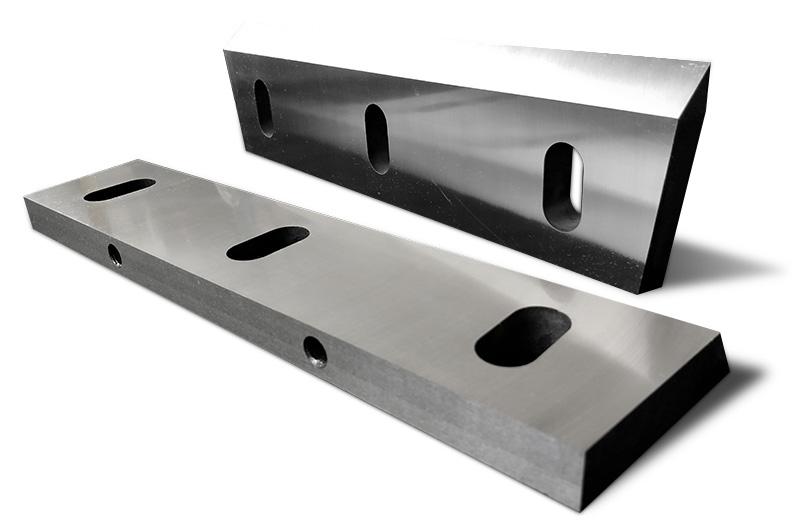
Knives are one of the most important components of granulators, and their properties are fundamentally influenced by the material they are made of. In this part we focus on the steel alloy designated DIN/EN: 1.2379, which we recommend as the most suitable and proven material for manufacturing granulator knives.
Characteristics of alloys
Alloys are mixtures of materials containing at least one metal; they are produced by melting and subsequently mixing the individual components. The atoms of an alloy do not bond chemically, which creates an irregular structure that increases the melting point and strength of the resulting material.
Steel is a specific alloy whose base consists of iron and carbon. Iron is the main component, while carbon and other elements are present in smaller amounts.
Key terms
- Strength: the maximum load before permanent deformation
- Toughness: the amount of energy a material absorbs before it cracks or breaks off
- Hardness: the resistance of a material to scratching or denting
- Brittleness: the tendency to fracture without plastic deformation
Alloy 1.2379 – cold-work tool steel
Steel 1.2379 is the most frequently used material for manufacturing granulator knives in the recycling industry. It is characterised by extreme wear resistance thanks to its high hardness, which means that knives made of this material last a long time without significant wear. Lower toughness and higher brittleness are a consequence of this hardness, so the material is suitable mainly for applications with minimal impact load, for example when processing plastics, wood or rubber with a low metal content.
Chemical composition by weight
| C | Si | Mn | P | S | Cr | Mo | V |
|---|---|---|---|---|---|---|---|
| 1.40 – 1.60% | 0.10 – 0.60% | 0.10 – 0.60% | ≤ 0.030% | ≤ 0.030% | 11.0 – 13.0% | 0.70 – 1.20% | 0.50 – 1.10% |
The performance of steel 1.2379 is determined by its chemical composition and structure. A high carbon content means an increased number of carbides, especially chromium-rich carbides, which are very hard and increase abrasion resistance. The steel matrix holds the carbides in place, which prevents loss of material during normal use, and the knife's cutting edge stays sharp for longer. A higher number of carbides reduces the alloy's ability to absorb impact energy and makes it more susceptible to damage from sudden impacts, for example on contact with metal objects. In applications with moderate or controlled impacts, however, alloy 1.2379 is very suitable thanks to its annealed Brinell hardness (HBW) of 255 (+A).
The high proportion of vanadium contributes to the formation of very fine and hard vanadium carbides, which fill the gaps between the larger chromium carbides. Molybdenum prevents the carbides from clustering and ensures their even distribution. Other elements deoxidise and strengthen the matrix, thereby contributing to the stability of the steel.
Conclusion
Cold-work tool steel 1.2379 is a proven material with the highest wear resistance and is the ideal choice for manufacturing granulator knives in applications with minimal impact load.
Contact
If you have any questions or are interested in purchasing top-quality knives, do not hesitate to contact us by e-mail or phone.