Manufacturing material
The Most Suitable Material for Manufacturing Twin-Shaft Shredder Knives
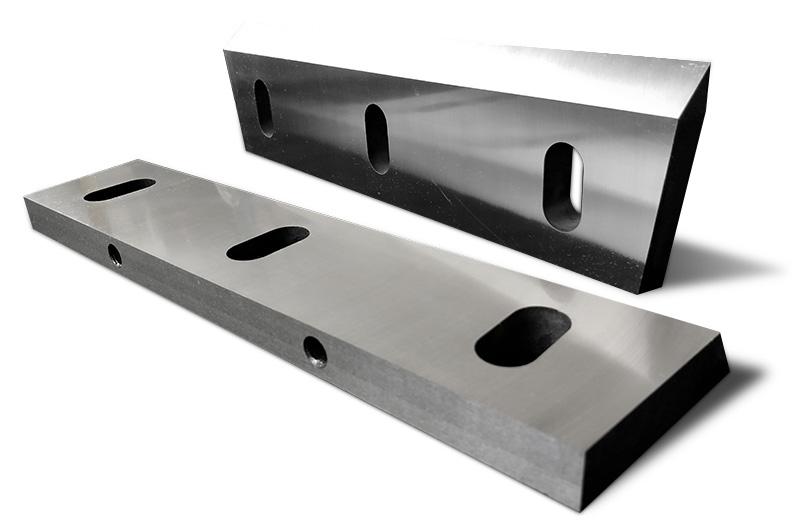
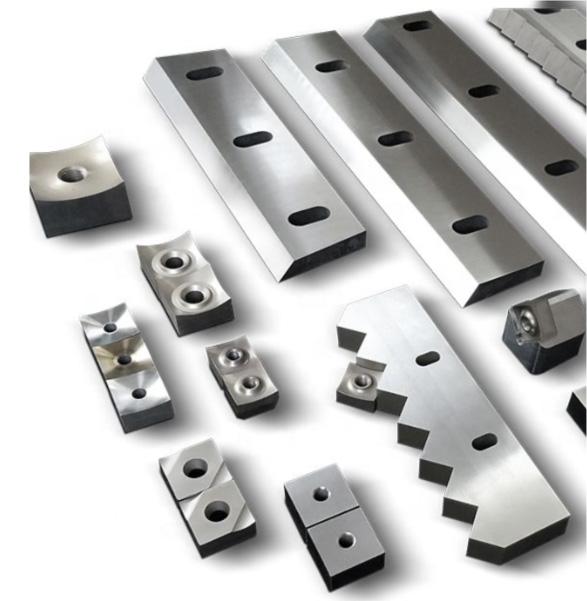
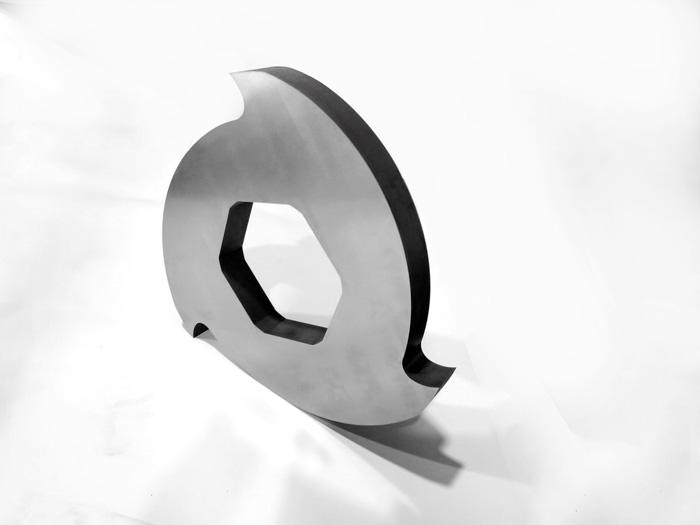
Knives are a key component of shredders, and their properties are determined mainly by the material used. In this part we focus on the steel alloy DIN/EN: 1.2990, which we recommend as the most suitable and proven material for manufacturing knives for twin-shaft shredders.
Characteristics of alloys
Alloys are mixtures of materials that contain at least one metallic element and are produced by melting and subsequently mixing the individual components. No chemical bonds form between the atoms of an alloy, which results in an irregular structure. This increases both the melting point and the mechanical strength of the resulting material.
Steel is a type of alloy based on iron with added carbon. Iron makes up the main share, while carbon and other elements are present only in smaller amounts.
Key terms
- Strength: the maximum load before permanent deformation
- Toughness: the amount of energy a material absorbs before it cracks or breaks off
- Hardness: the resistance of a material to scratching or denting
- Brittleness: the tendency to fracture without plastic deformation
Alloy 1.2990 – cold-work tool steel
Alloy 1.2990 is a new generation of the improved alloy 1.2379. The chemical composition of the original 1.2379 was modified in this alloy to remove its main limitation – its relatively low toughness. This change made a significant increase in the toughness of the alloy possible with a minimal loss of wear resistance. The machinability of the material was also improved. The alloy is suitable for more demanding applications, for example mixed plastics, rubber, tyres with steel parts, wood, textiles, light metals or electronic waste, where high impact resistance is required.
Chemical composition by weight
| C | Si | Mn | P | S | Cr | Mo | V | Ni | Cu |
|---|---|---|---|---|---|---|---|---|---|
| 0.95 – 1.05% | 0.80 – 1.10% | 0.25 – 0.50% | ≤ 0.030% | ≤ 0.020% | 7.80 – 8.30% | 2.00 – 2.20% | 0.25 – 0.50% | ≤ 0.25% | ≤ 0.25% |
As this material is a steel alloy, its structure shows certain similarities to some other materials. However, it has several key differences that considerably improve its properties. The main differences are a slightly lower concentration of carbon and chromium and a higher molybdenum content.
Chromium tends to form large carbides, which act as blocky particles (blokové částice) disrupting the consistent structure of the alloy; this improves the wear resistance of the material, but also makes it brittle.
Molybdenum forms more rounded carbides and prevents chromium from clustering, thereby creating finer particles and providing secondary hardening.
Vanadium further refines the grain size and ensures the finest and hardest possible carbides. The result is a cleaner matrix with finer carbides, which increases toughness and energy absorption.
All of this results in an alloy with wear resistance similar to 1.2379, but with much higher toughness. Thanks to its better and more versatile structure, it is therefore widely replacing its predecessor.
Conclusion
Cold-work tool steel 1.2990 performs best where toughness and impact resistance are decisive. The balanced properties of this steel make it a suitable choice for processing materials that contain light metals.
Contact
If you have any questions or are interested in purchasing top-quality knives, do not hesitate to contact us by e-mail or phone.